MedIntegrity TA-200 Manufacturer & Supplier
TOC Analyzer TA-200
Overview
Designed and manufactured by MedIntegrity LLC — the TOC analyzer is built in our own factory, part of a 28-patent product line in pharmaceutical testing equipment.
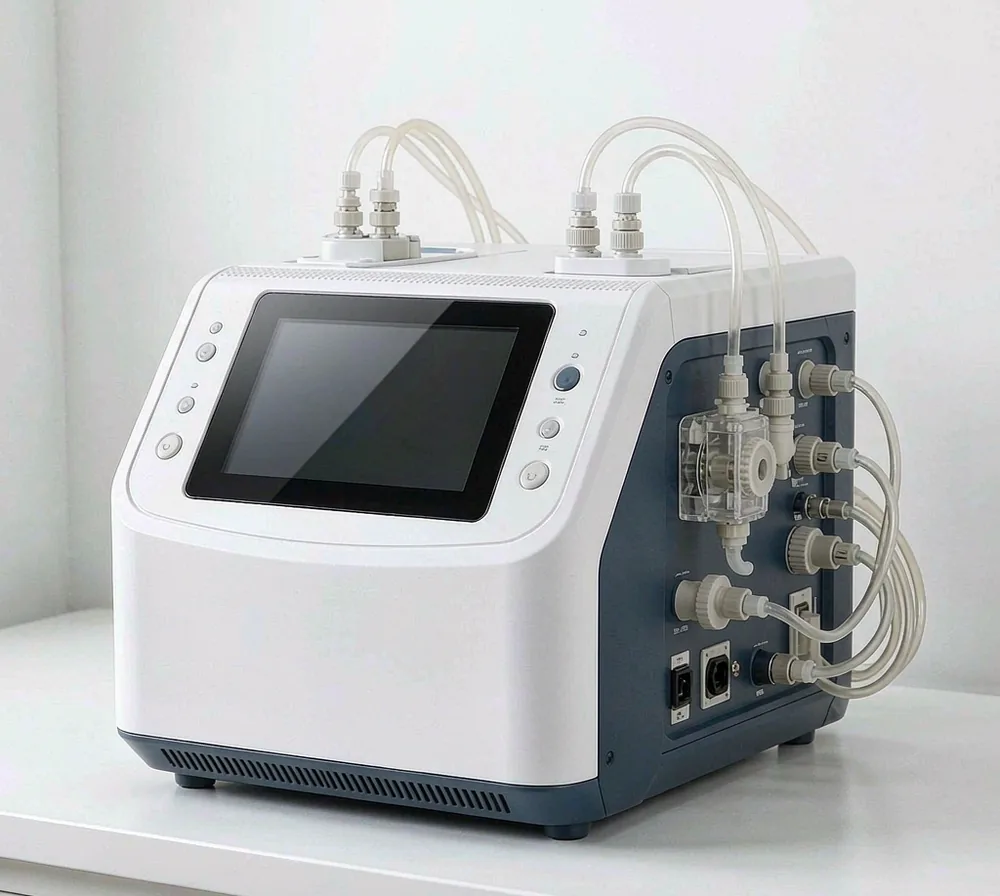
MedIntegrity TOC Analyzer TA-200 Establishing a reliable Water Quality Measure & Control StrategyMedIntegrity TOC Analyzer TA-200 features outstanding sensitivity and can accurately measure low concentration TOC. The analyzer is capable of detecting almost all conditions developed in accordance with GAMP guidelines, and offering full compliance with 21 CFR Part 11 is supported by an extensive qualification documentation package, including guides for Installation and Operational Qualification Performance Qualification(IQ/OQ/PQ). Total organic carbon (TOC) is often used as a non-specific indicator of water quality. In the natural process of our environment and the man-made processes of industry the ubiquitous nature of carbon provides a screening tool to determine the status of water quality. Customers need a reliable TOC system that can determine contamination from natural occurring compounds, man-made compounds, viruses, bacteria or biological growth.Total Organic Carbon analyzers determine the amount of total carbon in a sample aliquot. Total Organic Carbon is comprised of an Inorganic (TIC) and Organic fraction. The Inorganic fraction consists of the carbonate and bicarbonate compounds. In order to make an accurate determination of the Organic fraction, the analyzer must remove, or quantify, the Inorganic fraction of the sample aliquot. The high-temperature combustion method has been used for a wide variety of samples, but its utility is dependent on particle size reduction because it uses small-orifice syringes. The sample is homogenized and diluted as necessary and a microportion is injected into a heated reaction chamber packed with an oxidative catalyst such as cobalt oxide, platinum group metals, or barium chromate. The water is vaporized and the organic carbon is oxidized to CO₂ and H₂O. The CO₂ from oxidation of organic and inorganic carbon is transported in the carrier-gas streams and is measured by means of a nondispersive infrared analyzer, or titrated coulometrically.Because total carbon is measured, inorganic carbon must be removed by acidification and sparging or measured separately and TOC obtained by difference. Measure inorganic carbon by injecting the sample into a reaction chamber where it is acidified. Under acidic conditions, all inorganic carbon is converted to CO₂ which is transferred to the detector and measured. Under these conditions organic carbon is not oxidized and only inorganic carbon is measured. Alternatively, convert inorganic carbonates to CO₂ with acid and remove the CO₂ by purging before sample injection. The sample contains only the nonpurgeable organic carbon fraction of total carbon: a purgeable organic carbon determination also is necessary to measure TOC.For more information, please contact MedIntegrity. Principle: The sample is homogenized and diluted as necessary and a microportion is injected into a heated reaction chamber packed with an oxidative catalyst such as cobalt oxide, platinum group metals, or barium chromate. The water is vaporized and the organic carbon is oxidized to CO₂ and H₂O. The CO₂ from oxidation of organic and inorganic carbon is transported in the carrier-gas streams and is measured by means of a nondispersive infrared analyzer, or titrated coulometrically.
Technical Specifications
| Power Requirements | AC100~260V, 50/60Hz |
|---|---|
| Consumption | 120W |
| Maximum Salinity | 85μg/L |
| Nitrogen/Oxygen | 99.995% |
| Reproducibility | 3% |
| History Function | ≥5 Years storage |
| Weight | 32 Kg (Net) |
| Electronic Testing Record | Yes |
| Response Time | <4 min |
| Measuring range | 0~3000mg/L (Extensible)Detection Limit is 50μg/L |
| Nitrogen/Oxygen | ≥ 99.995% |
| Reproducibility | ±3% |
| Easily accessible calibration ports | √Qualify Standards is GMP |
Specifications subject to change for improvement without notice. For the latest data sheet or technical questions, contact your MedIntegrity representative.
In practice, the TA-200 measures 0~3000mg/L (Extensible)Detection Limit is 50μg/L, with a 0~3000mg/L (Extensible)Detection Limit is 50μg/L detection limit, and a full read in <4 min. Short enough for routine water checks, and the electronic record keeps the audit trail clean. Send us your water matrix and we'll confirm the fit.
Technical Documentation
Notes From Our Technical Documentation
TOC Analysis Requirements of regulatory inspection & Key Points of Supervision
TOC is an Oxidation Reaction Total organic carbon (TOC) is often used as a non-specific indicator of water quality. In the natural process of our environment and the man-made processes of industry the ubiquitous nature of carbon provides a screening tool to determine the status of water quality. Customers need a reliable TOC system that can determine contamination from natural occurring compounds, man-made compounds, viruses, bacteria or biological growth.Total Organic Carbon analyzers determine the amount of total carbon in a sample aliquot. Total Organic Carbon is comprised of an Inorganic (TIC) and Organic fraction. The Inorganic fraction consists of the carbonate and bicarbonate compounds. In order to make an accurate determination of the Organic fraction, the analyzer must remove, or quantify, the Inorganic fraction of the sample aliquot.
Test Method
Total Organic Carbon Determination by High Temperature Oxidation Combustion for Standard Method 5310B
Technical Guide
High-temperature combustion, in the Standard Method 5310B sense
The TA-200 is the TA series instrument for the high-range end of TOC: a measuring range of 0 to 3000 mg/L (extensible) and a detection limit of 50 µg/L, where UV oxidation instruments top out and the combustion method takes over. The method follows the high-temperature oxidation combustion route of Standard Method 5310B: a microportion of the (homogenized and diluted as necessary) sample is injected into a heated reaction chamber packed with an oxidative catalyst, the water is vaporized, the organic carbon is oxidized to CO2 and H2O, and the CO2 from oxidation is transported in the carrier-gas stream and measured by a non-dispersive infrared analyzer.
That is the method the water community recognizes for high-range TOC, and it is the reason the TA-200's numbers are comparable to the numbers your regulators and your treatment partners are already working with. The response time is within 4 minutes, the reproducibility is ±3%, and the instrument requires a nitrogen/oxygen supply of 99.995% or better — the carrier-gas specification of the method, written into the instrument's requirements so the setup matches the method from the first run.
Built for the range where UV instruments stop
The 3000 mg/L upper limit is where the TA-200 sits in the TA family: process water, wastewater treatment evaluation, and the high-concentration end of environmental monitoring, where the question is no longer 'is this at the 1 ppb level' but 'what is the organic load across the treatment train'. The maximum salinity specification of 85 g/L keeps it usable on water that is anything but clean, and the easily accessible calibration ports keep the maintenance cycle short enough that the instrument stays in service rather than in the calibration queue.
The instrument is a 32 kg benchtop unit, GMP-qualified, with an electronic testing record on the instrument and history storage of five years or more. Power is AC 100–240 V at 50–60 Hz (120 W).
The data, and the program it supports
Every measurement is an electronic record — the value, the time, the operator, the calibration state — stored on the instrument for five years or more. For a treatment program, that is the trend line: the organic load across the train over months, the effect of a change in the process, the evidence for the regulator's question about what the plant was doing in the quarter in question.
The instrument is developed in accordance with GMP and offers full compliance with 21 CFR Part 11, with data integrity as part of the design rather than an afterthought. When the program spans the low end (the TA-2.0 / TA-3.0 at 0.001 mg/L) and the high end (the TA-200 at 3000 mg/L), the record format is the same — which is what keeps a multi-instrument water program readable as one program instead of three.
Where the TA family hands off
Every TOC instrument has the end of its range, and the TA-200 is where the family's hand-off happens: a measuring range of 0 to 3000 mg/L (extensible) with a 50 µg/L detection limit, where the UV oxidation instruments of the TA-2.0 / TA-3.0 / TA-100 line top out and the combustion method takes over. The question at this end of the range is no longer 'is this at the 1 ppb level' — it is 'what is the organic load across the treatment train,' and the answer is a number per the recognized method, not an estimate.
The high-temperature combustion route of Standard Method 5310B is what makes the answer comparable: a microportion of the sample, homogenized and diluted as necessary, is injected into a heated reaction chamber packed with an oxidative catalyst, the organic carbon is oxidized to CO2, and the CO2 is transported in the carrier-gas stream and measured by a non-dispersive infrared analyzer. That is the method your regulators and treatment partners are already working with, and the carrier-gas specification of 99.995% nitrogen/oxygen is written into the instrument's requirements so the setup matches the method from the first run.
The trend line across the treatment train
For a treatment program, the value of the instrument is the trend line: the organic load across the train over months, the effect of a change in the process, and the evidence for the regulator's question about what the plant was doing in the quarter in question. Every measurement is an electronic record on the instrument — the value, the time, the operator, the calibration state — stored for five years or more, so the history is a pull, not a reconstruction.
When the program spans both ends of the range — the low end at 0.001 mg/L and the high end at 3000 mg/L — the record format is the same on both instruments, which is what keeps a multi-instrument water program readable as one program instead of three. The 32 kg benchtop design, GMP qualification, and the easily accessible calibration ports keep the instrument in service rather than in the calibration queue, where the 85 g/L salinity specification keeps it usable on water that is anything but clean.
Frequently Asked Questions
What method does the TA-200 use?
High-temperature oxidation combustion per Standard Method 5310B: a microportion of the sample is combusted in a heated reaction chamber with an oxidative catalyst, and the CO2 is measured by a non-dispersive infrared analyzer.
What is the measuring range?
0 to 3000 mg/L (extensible), with a detection limit of 50 µg/L — the high-range end of the TA family, where UV oxidation instruments top out.
What carrier gas does it need?
Nitrogen/oxygen of 99.995% or better — the carrier-gas specification of the combustion method, written into the instrument's requirements.
What is the maximum salinity?
85 g/L — usable on process water and wastewater that is anything but clean.
What about data and qualification?
GMP-qualified, 21 CFR Part 11 compliant, electronic testing record on the instrument, history storage of five years or more, easily accessible calibration ports. 32 kg net, AC 100–240 V, 50–60 Hz, 120 W.
Does the TA-200 support the USP <43> three-stage determination of purified water?
See the specification table above for this model's applicability; we'll confirm fit for your water system.
Is it suitable for pharmaceutical water systems?
Yes — TOC analysis for pharmaceutical water and process water, from routine monitoring to system qualification.
Which pharmacopeial standards are covered?
USP, JP and ChP water-testing requirements, with model-by-model applicability listed in the specification table above.
Need a quote or technical advice?
Tell us your application — our U.S. team responds with product selection, documentation and pricing.
Request a Quote