MedIntegrity MFT-1000 Manufacturer & Supplier
MFT-1000 Packaging Leak Tester
Overview
Designed and manufactured by MedIntegrity LLC — the packaging leak tester is built in our own factory, part of a 28-patent product line in pharmaceutical testing equipment.
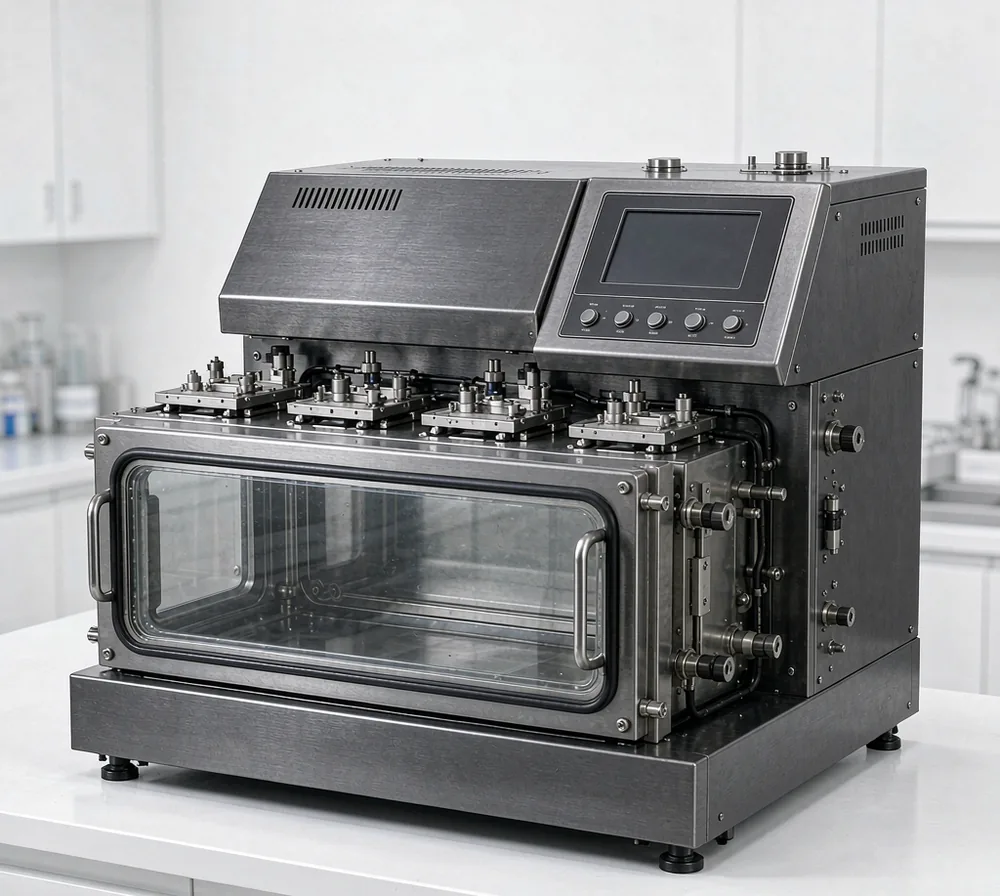
MedIntegrity Container Closure Integrity Test (CCIT) for Pharmaceutical industryContainer Closure Integrity Testing (CCIT) is a critical quality control process in the pharmaceutical industry, helping ensure that sterile products remain free from contaminants.The MedIntegrity MFT-1000 Packaging Leak Tester featuring the flexibility to accommodate a wide range of products and packaging formats. With the capability to detect leak rates as low as 2micron depending on package specifications, the Medintegrity MFT-1000 Packaging Leak Tester is the optimal non-destructive quantitative test method for many pharmaceutical and food applications.MedIntegrity ·USANote:Please so kindly understand that the information and specification in this catalogue are subject to change for improvement without notice.If necessary,or any technical question,please contact your MedIntegrity representative. MedIntegrity technologies were used to develop ASTM F2338 Test Method (Vacuum Decay). The vacuum decay method of leak testing is a physical measure of package integrity which FDA recommended. Using the ideal gas law and introducing time to establish a rate of change of gas volume lost to leakage, a relationship of changes in pressure in the system volume can be derived.FDA Recognized Consensus Standards: ASTM F2338 Vacuum Decay Test Method for package integrity testing. As the driving forces behind safety evaluation of materials and container closure systems in the US, the United States Pharmacopeia (USP) and Food and Drug Administration (FDA) enforce stringent requirements for Container Closure Integrity Testing (CCIT). In 2016, USP issued guidance USP<1207>; <1207.1> and <1207.2> that deterministic methods are preferred over probabilistic methods because they are able to achieve reproducible and predictable results at low detection limits for CCIT.In the current version of USP <1207>, there are a total of four subsections. USP <1207.1> discusses critical background information and rationale for the selection of an appropriate test method. Included in this subchapter is a detailed discussion of container closure integrity testing and evaluation during a product life cycle, which states: Package integrity verification occurs during [at least] three product life cycle phases: 1) the development and validation of the product-package system, 2) product manufacturing, and 3) commercial product shelf-life stability assessments". The idea behind such a statement is that container closure integrity should be built into the design of the product-package system and the processes that yield it.ISO 11607 AND 11608 regulatory guidance documents related to sterile barrier packaging Requirements for materials and packaging systems.NOTE:The information and specifications in this document are subject to change without notice. The Medintegrity MFT-1000 Packaging Leak Tester is the most sophisticated and full-featured non-destructive micro leak tester on the market today for liquid filled and lyophilized vials, ampoules, empty & prefilled syringes, as well as other types of rigid and flexible packaging. Test components are optimized for high sensitivity applications and high resolution requirements of the pharmaceutical industry. The Medintegrity MFT-1000 Packaging Leak Tester technology utilizes the ASTM vacuum decay leak test method (F2338-09) & pressure decay method recognized by the FDA as a consensus standard for package integrity testing to deliver highly accurate results. The modular, portable design of the MFT-1000 is suitable for a wide range of testing applications in both laboratory and production environments. The operator touch screen display shows test result data and provides easy to use screens for all machine operations.
Technical Specifications
| Storage Temperature | 5~50°C |
|---|---|
| Qualify Standards | GMP |
Specifications subject to change for improvement without notice. For the latest data sheet or technical questions, contact your MedIntegrity representative.
In practice, the MFT-1000 runs seal and leak checks on your package format without dye or destructive sampling, and stores each result as a traceable record. Tell us your format and line rate and we'll confirm the setup.
Technical Documentation
Notes From Our Technical Documentation
Model Information & Core Product Description
Model:MFT-1000 The Medintegrity MFT-1000 Packaging Leak Tester is the most sophisticated and full-featured non-destructive micro leak tester on the market today for liquid filled and lyophilized vials, ampoules, empty & prefilled syringes, as well as other types of rigid and flexible packaging. Test components are optimized for high sensitivity applications and high resolution requirements of the pharmaceutical industry. The Medintegrity MFT-1000 Packaging Leak Tester technology utilizes the ASTM vacuum decay leak test method (F2338-09) & pressure decay method recognized by the FDA as a consensus standard for package integrity testing to deliver highly accurate results. The modular, portable design of the MFT-1000 is suitable for a wide range of testing applications in both laboratory and production environments. The operator touch screen display shows test result data and provides easy to use screens for all machine operations.
Applicable Package Types
Chamber Multiple Package Type·Syringes·Vials·Filled & sealed bottles & cups·Ampoules·Non-porous pouches·BFS containers·Ophthalmic dropper bottles
Technical Specifications
Measurement Method is Vacuum Decay & Pressure Decay Instrument Dimensions is 430mmx655mmx420mmx330mmWeight is 51Kg(Net)Primary Power is AC100~240V 50~60HzElectronic Testing Record is Yes
Technical Guide
Two decay methods in one instrument
The MFT-1000 carries both the vacuum decay method and the pressure decay method. Vacuum decay seals the package into a test volume, brings the volume to a set level, and reads the leak from the time-based pressure change — the ASTM F2338 route, the FDA-recognized consensus standard for package integrity testing. Pressure decay works from the other side of the balance: the volume is pressurized, and a leak shows up as pressure falling over time. Together the two methods cover the full range of sealed rigid and flexible formats in a pharmaceutical plant.
Both methods are deterministic in the USP <1207> sense — a direct pass/fail against a defined criterion, reproducible and predictable, at low detection limits. With the capability to detect leak rates as low as 2 microns depending on package specifications, the instrument gives you a quantitative answer you can trend across a production campaign and stand behind at audit.
The chamber decides how many formats you can run
The multiple package type chamber is where the MFT-1000 earns its place: syringes, vials, filled and sealed bottles and cups, ampoules, non-porous pouches, BFS containers and ophthalmic dropper bottles, all in one instrument. When a site runs several formats, that means one documented method set and one audit trail instead of a different instrument per format.
The test components are optimized for high-sensitivity applications and the high-resolution requirements of the pharmaceutical industry, and the operator touch screen display shows the test data and the machine operations without a separate control station.
Built for the release line
At 51 kg net with a footprint of 430 × 655 × 420 × 330 mm, this is a fixed installation for the release area rather than a portable. Power is AC 100–240 V at 50–60 Hz, the instrument qualifies to GMP, and it stores results as electronic testing records — the release test result is a record from the moment it is made.
The life-cycle framing from USP <1207.1> applies directly: integrity verification across development and validation of the product-package system, manufacturing, and shelf-life stability, with ISO 11607 / 11608 covering the sterile barrier packaging around it. One instrument, one method set, and the record trail that ties the three phases together.
The multi-format chamber in daily operation
The multiple package type chamber is where the 1000 earns its fixed-installation place. A site that runs syringes, vials, bottles and cups, ampoules, non-porous pouches, BFS containers and ophthalmic dropper bottles is not going to keep a benchtop for every one of them; the 1000 covers them with a chamber set that changes per format — swap the chamber and the fixture for the format in hand, not the instrument, not the method, not the procedure.
For the release area that is the real saving: one fixed installation, one documented method set, and one audit trail across every format the site ships. Changeover is a chamber change, and the electronic record and the compliance documentation stay the same regardless of which format is in the chamber — which is exactly what a multi-format release line needs to keep its paperwork as fast as its production.
Frequently Asked Questions
Which methods does it run?
Vacuum decay and pressure decay, in one instrument — covering sealed rigid and flexible formats across the plant.
Which formats does the chamber accept?
Syringes, vials, filled and sealed bottles and cups, ampoules, non-porous pouches, BFS containers and ophthalmic dropper bottles, per the multiple package type chamber.
Is the test destructive?
No. Both methods are non-destructive quantitative measurements; the tested package can be released to the line and the result is stored as an electronic record.
How small a leak can it detect?
Leak rates as low as 2 microns, depending on package specifications — the detection limit for your specific format is set during method development.
Power, footprint and qualification?
AC 100–240 V, 50–60 Hz; 51 kg net; 430 × 655 × 420 × 330 mm; GMP qualification with electronic testing records.
Which package formats can the MFT-1000 test?
Blister, pouch, sachet and rigid containers — seal and leak integrity testing with traceable electronic records.
Does it produce auditable records?
Yes. Test results are stored as traceable electronic records for quality documentation.
How do I choose within the MFT family?
The MFT family covers different line capacities. Tell us your package format and testing volume and we'll recommend the matching instrument.
Need a quote or technical advice?
Tell us your application — our U.S. team responds with product selection, documentation and pricing.
Request a Quote